


A look at market psychology, crowded trades, and why collective sentiment can often create a disconnect between expectations and reality.
SpaceX (SPCX) went public on June 12, 2026 and officially became the largest IPO in history, raising $75 billion on 555 million shares. Before going public, retail investors were desperately clamoring to get their piece of the IPO, submitting a staggering $70 billion orders to brokerage firms. Just four days after going public, the stock blasted off from its initial price of $135 to $225. And then suddenly, the euphoria wore off as SPCX started coming back to Earth. By August 3rd, SPCX reached its current low of $104.83, an over 50% decline off its highs from less than two months prior, and just days before another 911 million shares were set to unlock on August 6.
What Are These Lockup Periods?
Lockup periods are put in place to keep the company's insiders (which are their earliest investors, founders, and employees) from selling their shares immediately after the company goes public. Many insiders have held shares for years at a very low cost basis, but their illiquid net worth may have ballooned significantly, and they're looking to cash out at the IPO and finally buy their mini mansions. But if too many insiders sell all their shares at once, that could cause a large supply of shares to hit the market, potentially putting immediate downward pressure on the price. Lockup periods slow the amount of shares coming to the market, and lockup expirations give future investors transparency on when that supply shows up.
SpaceX Has Multiple Lockup Expirations Coming
Currently, there are a total of 13.08 billion shares of SPCX, with Elon Musk holding around 6.4 billion shares by himself, which is roughly 49% of the company. There are nine lockup expirations that will take place from now until December 8, 2026, when all 51% of SPCX's available shares become publicly accessible. Musk's 6.4 billion shares will still remain under lockup until June 2027, meaning he cannot sell any of his own shares during any of these lockup expirations.
Everyone Sees the Tidal Wave Coming
Leading up the the August 6 lockup expiration, there was plenty of concern focusing on the potential downside of 911 million more shares becoming available, on top of the fact that SpaceX had already declined below its IPO price. Broad retail sentiment overwhelmingly remained pessimistic. And indeed, when August 6 rolled around, daily trading volumes surged dramatically as insiders started cashing out their shares:
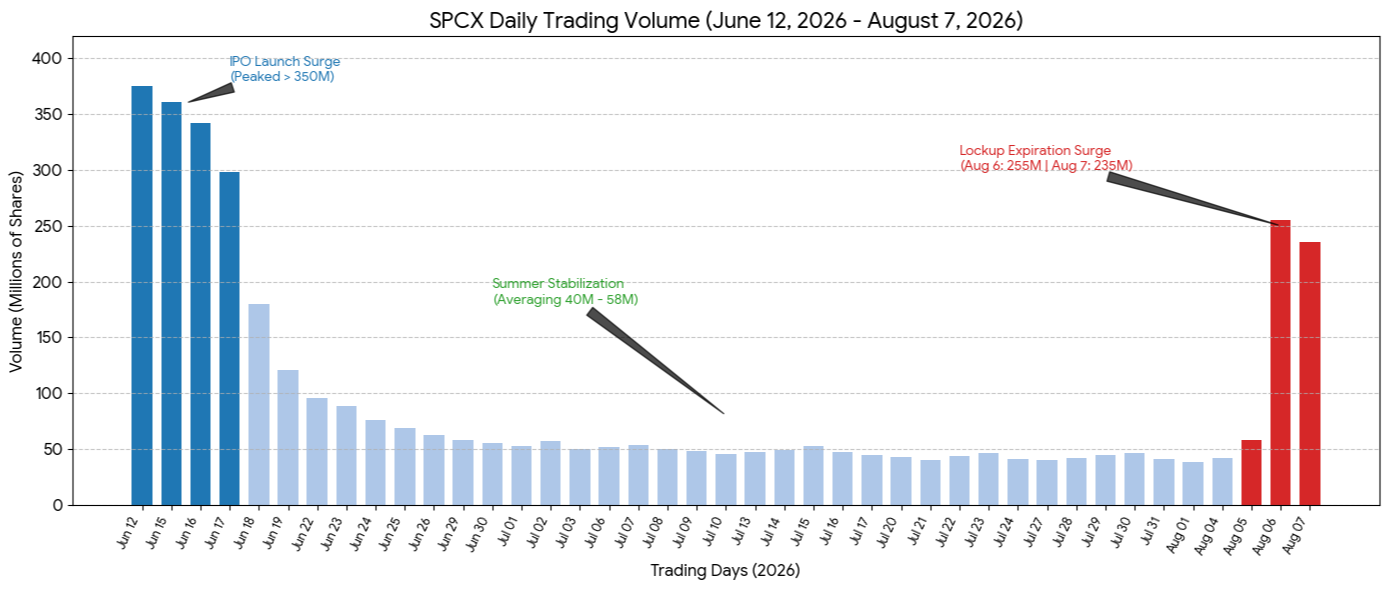
Figure 1: SPCX Daily Trading Volume (June 12, 2026 - August 7, 2026). Source: Public exchange market data. For illustrative purposes only.
All through July, trading volume had stabilized between 40 million to 58 million shares traded daily. But upon the lockup expiration, daily volume roughly quadrupled on August 6 and 7 to 255 million and 235 million. What the crowd consensus worried about was playing out exactly as feared. A tidal wave of unlocked supply was now hitting the open market. That can't possibly be a good sign for SpaceX's stock price, can it?
Rumors of My Death Are Greatly Exaggerated
On August 5, SPCX closed at $108.27. But on August 6, as the 911 million shares unlocked, instead of dropping further, SPCX ended up closing the day well in the positive on massive volume at just under $115. And on August 7, with another day of enormous volume, SPCX closed into the weekend at $133, gaining over 15% on the day for a total two day gain of almost 23% since the unlock. Rather than the downward spiral that was expected, this newfound liquidity was quickly absorbed, likely catching short sellers off guard. So what happened?
The sudden reversal of SPCX suggests that when a market strategy appears too obvious, it's probably already too late. Trying to time the market around any one day event is generally highly speculative at best. If too many investors are crowding themselves into one side of the market, such as expecting a downward move, the event itself could end up simply running out of momentum, ready to move in the opposite direction and catch the masses on the wrong side.
I remember a very similar situation during COVID. The S&P 500 struck bottom on March 23, 2020. The peak to trough move, meaning from the highest point to the lowest, was the S&P 500 at 3386.15 on February 19, 2020 and hitting the bottom on March 23 at 2237.40, a drop of roughly 34%. In April, over 20 million jobs were lost in the US alone, the largest month over month employment decline in history. Oil prices even went negative for the first time ever, falling as low as minus $37 per barrel. Retail sentiment was at near absolute bottom during this time...and yet somehow the S&P 500 rocketed nearly 13% in April, its best single month performance since 1987.
Many were completely baffled at how this was even possible when it felt like the entire global economy had closed down. The S&P 500 staged a remarkable comeback virtually all through the rest of 2020, locking in a 16% total return and ending the year of COVID at an all time high of 3756.
It may not be the easiest thing to do, but when the herd of lemmings are headed for the cliff, it may help to ask questions first before joining them.
So are you saying it's time to rush in?
Once upon a time there was a farmer who had a son. They were poor but owned a beautiful stallion that worked their fields, but one day it ran away, and the neighbors said, "what terrible luck!" The farmer said "maybe". A few days later the stallion came back and brought a pack of horses, and now the farmer is rich. "What great luck!" said the neighbors. But the farmer said "maybe". The son tries to tame one of the horses, but breaks his leg. "What bad luck!" Again the farmer replies "maybe". Shortly after, war breaks out, and every able bodied young man must go to war. But since the son had broken his leg, he was not required to go to war. All the neighbors had their sons taken to war, saying "How lucky!" The farmer said "maybe".
Now that SPCX has climbed to $133 from its low just a few days ago of around $104, is it time to rush in? Remember that there are still eight more lockup expirations coming over the next few months. But could $104 have been the bottom? No one knows for sure, and attempting to guess where the bottom is would be fool's play. For investors looking to acquire a mega cap name like SpaceX with high volatility, rather than trying to time a single purchase, consider adding exposure systematically through Dollar Cost Averaging. You deploy fixed amounts of capital into an investment at pre-determined intervals, such as buying some every month or every two weeks, regardless of the price. Using a rules based method allows you to remove some of that emotional impulse while focusing on the longer term. It can feel better to own even a little bit of something rather than having nothing and waiting on the outside looking in.
Disciplined Approach, Strategic Opportunity
When thinking long term, lockup expirations and short term volatility don't necessarily need to be feared. All that negative sentiment and fearmongering may actually be exactly what's needed to think about the next opportunity presenting itself. Contact us today to see how a disciplined rules based approach could be a useful tool for your wealth management needs.
Disclosures: This material is for informational and educational purposes only and should not be construed as specific investment, legal, or tax advice, or a recommendation or endorsement of any particular security, strategy, or investment product. Space Exploration Technologies Corp. (SPCX) and the S&P 500 Index are mentioned purely as historical and illustrative examples of behavioral finance, market mechanics, and historical volatility. This commentary does not constitute an offer to buy or sell any security.
Dollar Cost Averaging (DCA) is a systematic investment strategy that involves continuous investment in securities regardless of fluctuating price levels. While DCA can assist in smoothing out short-term pricing fluctuations, it does not assure a profit, protect against a loss in a declining market, or guarantee that an investor's long term financial milestones will be met. Investors should consider their financial ability to continue purchases through periods of low or fluctuating price levels.
Asset allocation, portfolio reviews, and diversification strategies do not ensure a profit or protect against market loss. All investing involves risk, including the potential loss of principal. Past performance is no guarantee of future results. The historical examples provided (including the market events of Spring 2020) reflect specific structural regimes and are not predictive of future market behaviors. The views expressed are those of the author as of August 2026 and are subject to change without notice based on shifting macroeconomic, regulatory, or corporate conditions.