


Part 1 of 3: Guarding Assets Against Negative Asymmetric Risk
Every investor dreams of finding the perfect, life-changing trade. Find an investment that carries immense upside potential with low downside exposure. In the financial world, this is called positive asymmetric risk.
But what often happens is investors get blinded by a hot tip or high personal conviction, leading them to emotionally chase into negative asymmetric risk, a scenario where the potential downside dramatically outweighs any possible reward.
That high conviction can be a killer.
I've heard stories, including from my own family members, of buying into a stock because it looked cheap, only for it to get cheaper. And due to misplaced belief, they bought the dip. And as it got cheaper and cheaper, they dollar cost averaged into it further, only for it to keep getting cheaper to the point that it became completely worthless.
Sometimes, the greatest financial threats don't happen because of normal stock market volatility. They happen because we convinced ourselves that something was a home run idea, and it actually wasn't. And we didn't take the time to vet out the idea, play the devil's advocate, explore differing opinions, bounce feedback off of a professional, and truly understand the risk and potential downside involved.
To see how an unreviewed, high risk strategy can lead to an unrecoverable disaster, let's take a gander at the 2024 Paris Olympics.
If a Tree Falls in a Forest...
And no one is around to hear it, does it make a sound?
That sequoia crashed spectacularly into the Paris games.
Rachael Gunn, known in the breaking (the professional word for breakdancing) community as "Raygun," put together an instantly viral performance at the Paris Olympics. It was memorable to say the least, and attracted attention on a global scale. Unfortunately, it probably wasn't the type of attention she was hoping for. Her routine was immediately met with near-universal ridicule and intense cyberbullying.
Two years later, I watched the Netflix documentary showing exactly what happened behind the scenes. Turns out, Gunn actually knew she was completely outclassed by her international counterparts long before the Olympics began.
With the Olympics approaching quickly, Raygun realized she just didn't have the athleticism to pull off power moves such as headspins and windmills, a basic component of the world's elite breakers and virtually a prerequisite for winning. Raygun's husband, who was also her primary coach for the Olympics, suggested making a radical change.
Instead of incorporating the power moves she wasn't confident pulling off on the world's brightest stage, they decided to focus on "originality," a specific category that breaking judges score on. They designed a unique, Australian themed routine incorporating kangaroo hops and the sprinkler dance.
Trying something new and radical, not as a trial run at a smaller competition, but as the penultimate routine at the Olympics, well that itself is a huge risk. But not letting anyone besides her husband see the routine prior to Paris, not having any other professional provide feedback, that was catastrophic.
She already knew winning an Olympic match was out of reach, let alone having a chance to medal. She decided to risk it all in the hopes of trying to secure just one judge's vote, and maybe have some fun with it while trying something new. Unfortunately, in her three rounds of competition, she lost by a combined score of 54-0.
Not only did she fail to win over even a single judge as she had hoped, but the "originality" of her performance was almost unanimously mocked. The backlash was instantaneous, the damage to her reputation was irreversible, and she became an overnight internet sensation for all the wrong reasons. All to attempt to secure just one judge's vote. That is negative asymmetric risk to the extreme.
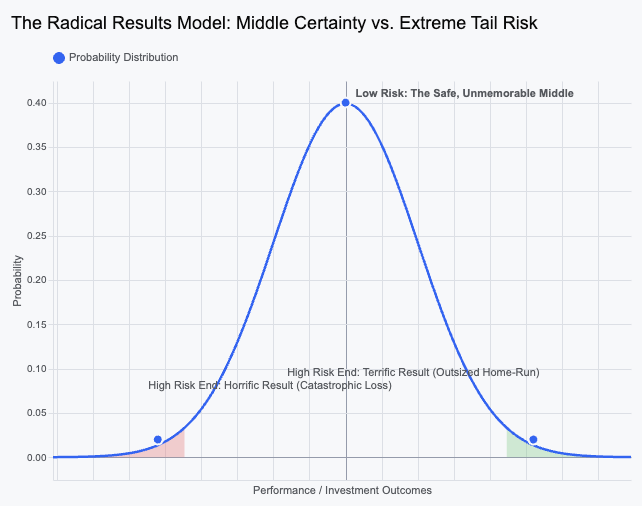
Figure 1: The Radical Results Risk Horizon Model - Comparing center hump predictability against extreme left and right tail risk parameters.
Take a guess where Raygun's memorable performance lands on this standard deviation chart?
I would venture to say that the reputational damage that occurred would land her firmly in the red zone.
Looking for a Home Run in the Red Zone
In the financial world, investors make this exact same "tree crashing" mistake every day with their portfolio selection.
Whether it be a hot tip from a friend or simply a strong personal conviction, an investor might allocate an oversized percentage of their capital into a highly speculative asset class. Sometimes it's Redditors refusing to sell a runaway stock during GameStop mania, only to give back enormous paper profits that turned into losses. Next time it could be a guy named Bernard dumping his life savings into a cryptocurrency based on the hit Netflix series Squid Game that many others also rushed into, only to discover it was all a fraud.
In the rush to land a swift and glorious victory, our brain shuts down our logic in recognizing what could be a very low probability of actually achieving such a victory. A sudden crippling loss could take years to recover from, as well as a mental toll that could prevent sound decision making in the future.
But I Like the High Ones!
One of Warren Buffett's famous nuggets of wisdom is to wait for the "fat pitch" and then swing as hard as you can. In other words, don't just chase any opportunity that flies at you. Take your time, do your research and don't rush. If you miss an opportunity, there will always be another. Or, as I learned while traveling in Switzerland, if you miss the train, the next one arrives in half an hour.
But what about people who just "like the high ones," as Kit tells her sister in A League of Their Own? That's why Raygun's performance won't be the last tree we hear crashing.
Opinions Are Like Noses
Yes, everybody has one. But a good nose might be able to help you sniff out ideas, opportunities, or risks that you hadn't had a chance to think of. Don't wait until the market stress tests your assets. Reach out to schedule an introductory portfolio review.
Up Next in This Series: Part 1 focuses on guarding our assets against potentially bad investment risks. Part 2, coming soon, explores how we need to take risk to enjoy our hard earned wealth.